Embarking on a study abroad program is one of the most exciting chapters of a college student’s journey. But knowing how to prepare for studying abroad can sometimes feel overwhelming. Most students traveling for the first time do not know where to begin. That is why the earlier you start preparing, the better the process will be. If you’re planning to study abroad this year, this complete step-by-step guide will help you prepare strategically, avoid costly mistakes, and feel confident before departure. Let’s dive into your ultimate study abroad checklist.

Disclaimer: This article contains affiliate links from our Affiliate Programs. We may receive a small commission if you purchase through the links at no additional cost to you. Please read our Disclosure for more information
6 Ways to Prepare for a Smooth Study Abroad Experience
- Get Your Study Abroad Documents in Order Early
One of the biggest mistakes students make, due to a lack of foresight, is underestimating the paperwork timelines. You need to secure four important documents, which are:
- Visas
- Passport
- Proof of enrollment/Acceptance Letter
- International travel insurance.
When it comes to your visa, make sure you research the requirements early in the study abroad planning process. Some misconceptions people have are that if they can enter a country legally without a visa, they do not need to apply for a visa when studying abroad. That is partially true if you are studying abroad for less than 90 days in a country where you typically wouldn’t need a visa.
Let’s suppose you are a U.S. citizen going to Spain for 3 months(90 days). You may not need a visa then. However, if you are going for a 4-month program, you will need a visa because that is more than 90 days. That is why doing proper research about your destination visa requirements is of utmost importance in the early stage of your study abroad planning. The earlier you begin, the better, as some visa applications can take weeks or even months to process.
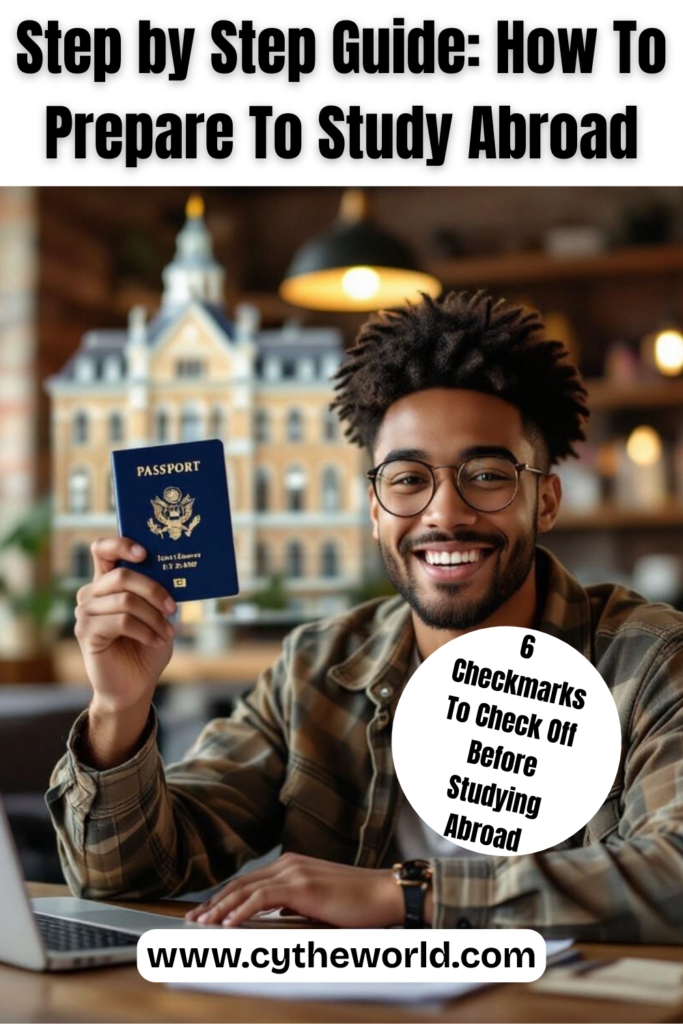
The next document you should have handy is a passport. Make sure you have a valid passport, valid for at least 6 months beyond your return date. This criterion is especially crucial if you are studying abroad for an academic year. Students going on a short-term program should also adhere to this rule: a passport will serve as your ID when you are abroad if you do not need a visa, but it can also hamper your visa application if you do.
The last two documents are to ensure you have your proof of enrollment and international health insurance. Now, it’s too early to have your proof of enrollment unless you are doing a summer program, for which you may receive your acceptance letter/proof of enrollment by late February. If that is the case, make sure you keep a digital and printed copy. As for insurance, research an international health insurance plan thoroughly before boarding any flight. It is a must-have for most study abroad programs.
One insurance company that can meet all your travel needs while abroad is AXA Travel Insurance. It insures you travel expenses, documents, and medical expenses. It is a great resource to look into. WorldTrips is another insurance agency that provides medical insurance to travelers worldwide. When you have all your documents, create a digital folder containing PDFs of all essential documents (passport, visa, insurance, emergency contacts). Store them in Google Drive or Dropbox for easy access. For physical copies, have a folder organizer like the Sooez Accordion File Organizer.

- Sort Out Your Finances Before Studying Abroad
Let’s be honest, navigating life is easier when your bank account isn’t adding to your stress. The same goes for navigating a new country. As someone who studied abroad three times with three different financial means, I will tell you that having more than enough money will significantly improve your experience. Here are four tips to ensure your finances are well sorted out before, during, and after studying abroad.
Before studying abroad, make sure you budget wisely. When you are studying abroad, understand that you will not be able to earn money. If you do not have a family to support you financially, make sure you have enough money in your savings from your job. Research your destination thoroughly and get an idea of how much you will spend each month. Do not just consider only rent and utility bills. Think of groceries, phone bill, transportation, excursions, and many more. You can use Facebook groups to ask for more personal accounts of living costs at your destination to get an idea. For budgeting, apps like Numbeo or Expatistan are great resources.

When I started traveling back in 2017, there was a rule requiring you to notify your bank before leaving the country so your card wouldn’t be flagged for fraud. Now, that rule no longer exists. Banks no longer require you to notify them. However, I advise you to ensure you take care of your bank account thoroughly before you leave. Make sure you pause any auto-payments you don’t plan to use while abroad. Pay off any credit card debt to eliminate the stressors while you are abroad, and before leaving, make sure you take out some cash in the currency of your destination to cover things like taxis, snacks, or minor emergencies.
While abroad, I recommend opening a local bank account, especially if you are studying abroad for an academic year or more. I opened a French account while in France, and a bank account while in Belgium. Although the popularity of credit cards allows us to make purchases abroad without worrying about transaction fees, most landlords prefer that you have a local bank account for easy transfers. Although it sounds scary, especially on your first time, opening a local bank account is easy for students in many countries and can save on foreign transaction fees if you do not have a credit card.
- Secure Housing Before You Arrive
One of the most important steps to ensure a smooth study abroad experience is arrange your housing accommodation before you arrive at your destination. I cannot stress this point enough. Never leave a place without securing the accommodation. During my time in Belgium, I learned the hard way, and I wouldn’t want you to make the same mistake. Whether you’re staying in student dorms, homestays, or private apartments, secure your housing before your flight.
Before leaving, make sure your acceptance letter includes the university housing option so you have peace of mind that the university you are going to has already arranged your housing. When applying to a program, check whether your host school offers on-campus or off-campus accommodations. When I was going to Sciences Po Rennes for my study abroad, I received my acceptance letter, which said I would be staying in a student dorm 10 minutes from the campus on foot. However, when I went to Belgium, I had to pay for my accommodation and rent in the private sector myself. If you find yourself in this category, make sure you do thorough research on your accommodation options.

Research the neighborhoods near the campus. Watch videos on the city where you will be based during your study abroad. I did that when I was preparing to move to Ghent, Belgium. It’s good to see the city, situate yourself, and decide where you would like to live. You can search for apartment options on websites like HousingAnywhere and Uniplaces, as well as on local Facebook groups for international students. When renting in the private market, make sure you understand your lease thoroughly. Being in a foreign land on your own means you have to be extra vigilant and critical. One mistake may cost you a lot of money and peace of mind. Read the lease and reread it. Know what is included in the lease, such as Wi-Fi, utilities, or furniture clauses.
Also, it is important to know the local laws regarding renting in your host city. Some landlords use international students’ naivety to scam them or commit illegal acts. During my time in Belgium, I experienced this. My landlord illegally evicted me over something I had no control over. I could not get my security deposit back because I made the mistake of handing it to him when the law permitted it to be placed in a hold account, which neither of us could access. So please, make sure you are well-informed before signing a lease.
- Prepare for Cultural Shock and Local Customs
Speaking of being well-informed, understanding the laws regarding renting is not the only law you have to know. Culture shock is real, regardless of how much you think you will do well in a place. Before going to China, I was studying Mandarin and Chinese cultures and thought I was ready for the cultural shock that hit me at Pudong International Airport. Although I could speak Mandarin, I froze when I landed and knew I was among native speakers, and felt like I would be made fun of. The same thing happened when I went to France, even though I am a native French speaker. These realities depict the reality of cultural shock. But the best way to ease into a new country and make integration easier is to prepare for it in advance.
Well, you may read the previous paragraph and wonder, if she was prepared and has the language skills and still experienced cultural shock, what’s the point of being prepared? Being prepared in advance does not mean you won’t experience cultural shock, but it means it will not have a debilitating effect as it would for someone who is not prepared. That is why, before traveling, your home institution would have an orientation day to prepare you for what’s to come. Familiarizing yourself with local cultures allows you to know what not to do or say in a particular culture. If you are studying abroad in a place where women dress modestly, you are less likely to pack a bootyshort, and it won’t occur to you to wear it publicly. That is why this step is vital.

Three essential factors to know when preparing are language, etiquette, and dress code. Learning a new language has tremendous benefits. We’ve previously discussed the 8 benefits of learning a new language. However, it’s unrealistic to expect most students studying abroad in a country where English is not the dominant language to acquire fluency before they arrive. Even I, a native French speaker, had trouble understanding the new French lingo trendy French teens were using. But that doesn’t mean you shouldn’t know the basics of your host country’s language. Even if most people speak English, knowing simple greetings in the local language goes a long way. It also allows you to integrate more easily and bridge cultural gaps. My experience in Shanghai was 100% sweeter than I expected, given my limited Mandarin-speaking skills. That is why language resources like Babbel and Rosetta Stone are great for building the basic language skills you need.
Lastly, it is important to know about the etiquette of your host country. Research local customs around greeting, punctuality, tipping, and personal space. In the United States, we say hello with hugs, whereas in some places, they think that’s too personal. Some cultures greet each other with two kisses on the cheeks, while others greet with a handshake or bow. Knowing what is acceptable in your host country shows locals you encounter that you are aware of their culture and earns you some brownie points. Punctuality is another thing to keep in mind when it comes to local customs. Some cultures have strict protocols regarding punctuality, like the Germans. As discussed earlier, knowing the local dress code helps you blend in and respect your host country. For your research, watch local YouTubers and TikTok creators to get a feel for everyday life in your new country.

- Register for Classes and Understand Academic Expectations
Most of the time, when we are preparing to study abroad, we focus on being abroad and forget about studying. Some people use studying abroad as a guise for being tourists, thereby diminishing its value. There are amazing benefits to studying in another country, such as learning different methodologies, gaining firsthand experience, and opening yourself up to many career opportunities. Thousands of students see a positive benefit to their careers after studying abroad. So I think it is a pity to use a study abroad program as a guise and take someone else’s place who could really put it to good use. If you are one of the people who truly want to study abroad, make sure you register for your classes and know the academic expectations.
The first thing to note is that, just as at your home institution, your education depends on you. Nobody will tell you to come to class or not. Attendance isn’t taken, as is the case at most universities, leaving your academic expectations up to you. If you are the type who pays attention and makes the most of your educational experiences, you will be fine. If you are not, you will have to be more proactive about the results you want. When it comes to curriculum, make sure you thoroughly understand how your host institution operates. In Shanghai, for example, when I studied there, I had to follow a specific curriculum. In France and in Belgium, I had the core classes I had to take, and other classes were electives. If you are hoping for “office hours” as in the American education system, you may not find them abroad. Some universities are simply lecture-based, and if you are in class, take note; if you are not, ask a classmate.

If you are seeking to transfer credit, as I did during my study abroad to both China and France, make sure to confirm with your home university how your study abroad credits will transfer. Study the class formats of your host institution, as that can be another set of cultural shocks. European universities, for example, often rely more on lectures and final exams than on continuous assessment. On the surface, it can look easy, but that means your final exams hold so much weight.
If you are a straight-A student, get comfortable with getting C’s, because some universities don’t believe in giving 20/20. You will hear local students say to just aim for a 10/20, which can mess up with someone who values grades. For that, I suggest ensuring that the transfer credit is not counted towards your GPA. Lastly, make sure you understand the instructions’ language. In China, my courses were in Mandarin, in France, they were in French, but in Belgium, they were in English. So make sure you are clear on language expectations for your exams as well to ensure a smooth study process.

- Plan Your Health and Medical Care
Lastly, one of the best ways to prepare for your study abroad program is to ensure you stay healthy and have a good plan for medical care. Don’t wait until you’re sick or have a medical emergency to figure out how to see a doctor in your host country. Before leaving, make sure your vaccinations are up to date. It is a good habit to check if any vaccines are required or recommended before landing in your host country. We listed several vaccines you should be familiar with getting before traveling abroad in this post.
The second thing you should know before traveling is the local healthcare systems. Learn how to access care, whether through the campus clinic, a private clinic, or public hospitals. Before signing up with local insurance companies, learn about their reimbursement policies. As someone who had never had to purchase a health plan or pay a co-pay, having to do that abroad was a new experience. It made me not want to go to the doctor’s, especially as an international student with a strict budget, when I was in Belgium. Therefore, make sure you do thorough research.
The next step is to ensure you have all your prescription medications with you. Ask your doctor for enough medication for your stay, and make sure you have your doctor’s note, just in case. Learn about the equivalent of your medication in your host country. For example, if you take ibuprofen, in most European countries it is called Nurofen or Brufen. However, if you want to save money because over-the-counter medicine can be pricy, especially if you are going to a country that has a higher cost of living, buy your over-the-counter medicine on Amazon. You can stock up on Tylenol Extra Strength or Advil Dual Action Back Pain, which are my personal go-to for menstrual cramps. I would also recommend that you invest in a first-aid kit whenever you travel. For nauseous and travelers prone to motion sickness, the Hionfurt Motion Sickness Band is a must-have for your travel medical care plan.
Medicine prescriptions are not the only prescriptions to have in hand. I found out the hard way when I landed in Athens, Greece, and realized I forgot my glasses back in Rhode Island. Navigating a foreign airport where I couldn’t really see where I was going, signs were in Greek, and I could barely read the English subtitles, made my adventure there a bit stressful. I almost missed my flight to Thessaloniki. When I arrived, I knew I could not spend the whole conference with blurry vision. Although I was able to find an eye care clinic, get a test, and get new glasses on the same day, my local guide told me how unusual that was and said I was very lucky. Please don’t hope for luck if you wear glasses or contact lenses or have a prescription for any medical problem. Make sure you are well-prepared.

Conclusion
In conclusion, studying abroad will stretch your strengths and weaknesses. It is a challenging process that can be easily won if you prepare accordingly. The earlier you begin planning, the more likely you are to ensure a smooth transition from your local university and country to your host university and country. Use this time to start focusing on one aspect of the study abroad preparation guideline we highlighted until the day of your departure. Make sure your travel documents are in order, and you have an effective medical care plan for emergencies and non-emergencies. Communicate with your host university about what to expect. Visit your school’s international office for more information on the orientation schedule. Your preparation will ensure a smooth studying abroad experience.
Until next time,
Happy studying abroad planning.
Let us know where you are studying abroad and ways we can support you throughout your journey.
Xoxo,
Cy!

Leave a Reply
You must be logged in to post a comment.